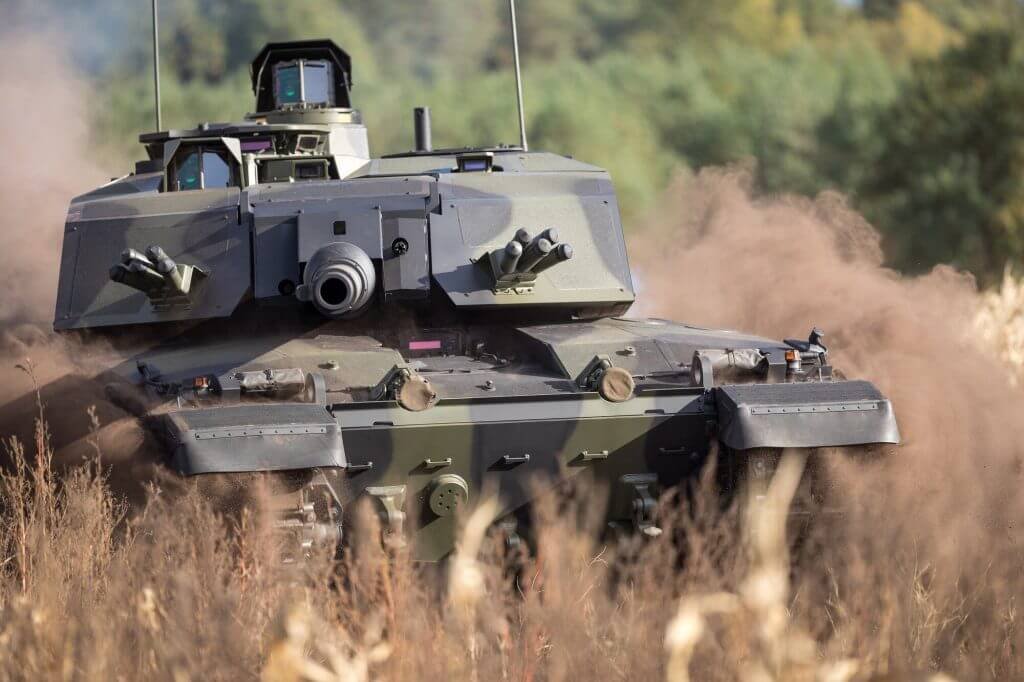
Rheinmetall has announced that the first mobility tests of the Challenger 3, the new tank of the British Army, have been completed in the UK, marking a significant advancement in the program.

These tests were used to gather data on platform noise and vibrations, as well as how they interact with the crew, and also on the effect vibrations have on the ammunition carried inside the pre-production vehicle.
Mobility Testing Trial
The testing was conducted by Rheinmetall BAE Systems Land (RBSL) in conjunction with the Authority and QinetiQ at various locations in the UK. The trial saw the total coverage of just under eight hundred kilometers, both on-road and off-road.
Once the final analysis is complete, the data collected will help RBSL mitigate potential risks, refining the vehicle delivered to ensure that it meets the requirements of the British Army.
In addition, this data will be used to schedule a test bench for turrets at Telford, enabling battlefield missions to be conducted from this cutting-edge facility, contributing to reliability tests for the Challenger 3 starting from 2026.
The Challenger 3 Program
The British Army ordered from Rheinmetall BAE Systems Land (RBSL) the production of 8 prototypes and 148 Challenger 3s as part of a contract worth over 800 million pounds.
The Challenger 3 represents a deep modernization of the currently in-line Challenger 2 with the British Army; it adopts a new turret from Rheinmetall armed with the 120L55 smoothbore and an observation and firing system derived from the Ajax family.
The ‘old’ Challenger 2 vehicle and engine are refreshed with new hydrogas suspensions to support a greater weight represented by the new modular armor system designed by the Defence Science and Technology Laboratory (DSTL), and also by the active protection kit (APS) Trophy from Rafael Advanced Defence Systems Ltd.
Source: Rheinmetall AG
Photo credit @Rheinmetall BAE Systems Land (RBSL)