Introduction
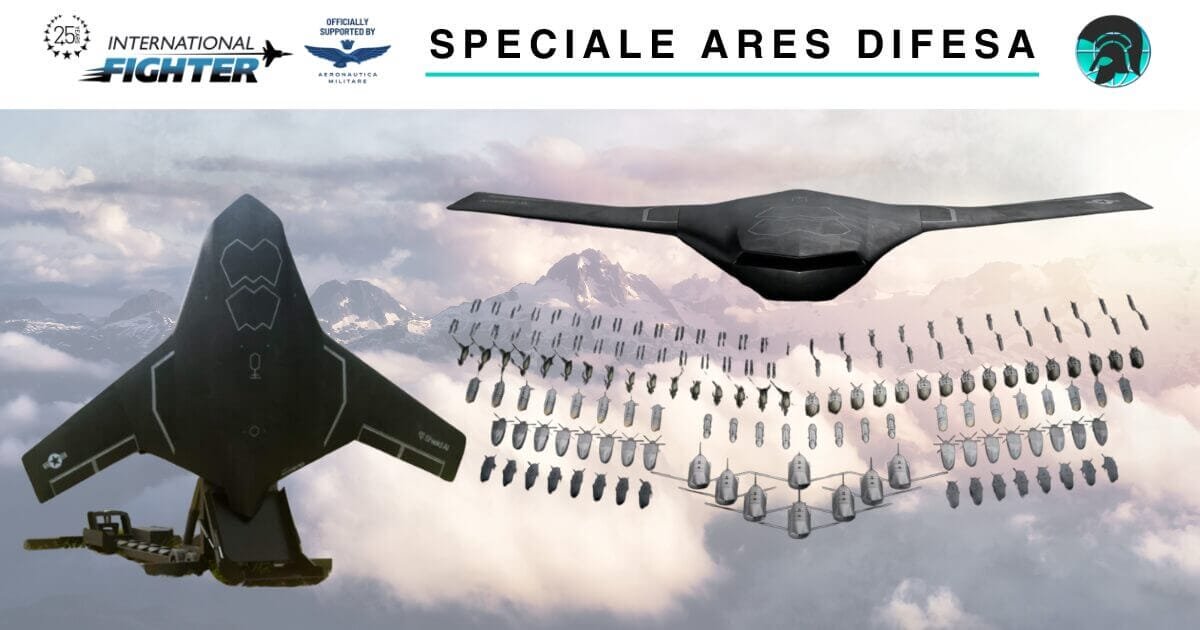
“Runways will be targets.” This premise guides the X-BAT project by ShieldAI, presented at the International Fighter Conference 2025 organized by DefenceIQ. In an environment where conventional infrastructure is easily identifiable and vulnerable, having an outstanding aircraft is not enough if it remains grounded.
The proposal of the American company is clear, echoing projects popularized until the 1960s: to design an aircraft engineered from the outset for vertical takeoff and landing (VTOL), road mobility and quick, distributed deployment, away from conventional runways.
Born as an expeditionary platform, X-BAT combines it with a fully autonomous system. The key idea is that if an aircraft can take off and return without relying on fixed bases, its vulnerability window reduces dramatically.
Description
The X-BAT is conceptualised as an autonomous combat aircraft combining high performance with compact dimensions. It can withstand maneuver loads greater than 4 g, reach maximum altitudes over 50,000 ft and cover more than 3,700 km fully loaded. The wingspan is approximately 11.9 meters, while the fuselage is 7.9 meters long and 1.5 meters high. In the configuration with folded wings, the overall dimensions are approximately 12.2 x 4.3 x 1.8 meters, allowing road transportation, embarkation on medium-sized naval units, and rapid re-entry into service in expeditionary scenarios.
Launch/Recovery

Technically, the X-BAT adopts a “tail-sitter” architecture with an engine mounted along the central axis: no complex lift-fans or tilting rotors, but a lighter and simpler solution that affords more room for fuel and payload.
In practice, thanks to “shoot-and-scoop” tactics and mobile launch/recovery systems, it’s possible to launch sorties, return, and reposition before the enemy can target you with precise fire or launch an aerial assault. The result is higher operational density: less transit time, more sorties, more resilience.
Takeoff and landing occur on a Launch and Recovery Vehicle, integrating protections against jets and debris, enabling operations from different surfaces, from semi-prepared terrains to naval platforms, even in harsh conditions or environments where GPS is degraded or absent.
Naval Use

The naval application is perhaps the most disruptive aspect: an aircraft with significantly smaller dimensions compared to an F-35B and autonomy estimated at around 2,000 nautical miles fully loaded allows the embarkation of dozens of units even on medium-sized ships, transforming non-dedicated units into air projection nodes (both military and civilian such as a container ship)
According to ShieldAI, Queen Elizabeth-class aircraft carriers can carry up to 80 X-BATs each. This reshapes the traditional concept of an aircraft carrier, offering nations that cannot afford supercarriers the opportunity to gain long-range maritime control and power projection capabilities.
Propulsion and Vector System

The propulsion apparatus relies on the tested General Electric F110 engine, the same one mounted on F-14, F-15, F-16. However, ShieldAI’s team made some necessary modifications to optimize it for the X-BAT. The minimum level the engine can be brought down to has been lowered compared to pilot applications and the need for pressurization, while the vectoring nozzle was derived from the F-16 VISTA (Variable Stability In-flight Simulator Test Aircraft) program from the early ’90s.
These modifications allow the drone to transition from leveled to vertical flight to prepare for landing, replicating half of Pugachev’s Cobra famed maneuver — achieving an angle of attack of about 90 degrees.
Decisional Autonomy, to a Certain Extent
The X-BAT is not just structure, but a multirole platform designed to launch air-to-air and air-surface weapons, in addition to carrying high-power electronic warfare payloads. The addition of advanced autonomy, developed and tested in complex and GPS-denied scenarios, allows operations even with intermittent communications, maintaining rapid software updates to adapt the system to battlefield dynamics.
ShieldAI emphasizes that their autonomy is not an out-of-control agent: the system operates within programmable rules of engagement and can be modulated based on the level of human intervention required.
The Program

ShieldAI lays out a roadmap with first flights expected for mid/late 2026 and production around 2029, ambitious timelines but supported by risk mitigation strategies and strong software-hardware integration. The company aims to keep the aircraft cost in line with other companion combat aircraft (CCA) being acquired by the USAF and achieve an operating cost ten times lower than that of the F-35.
Finally, the company’s industrial philosophy has a clear international vocation. The platform is designed as an open system onto which nations can integrate their own mission systems, sensors, and rules of engagement – maintaining sovereignty over their critical capabilities. This modular approach, coupled with operational experience honed in real theaters, is at the heart of ShieldAI’s bet: to provide a tool that not only expands tactical options but changes how the positioning and survival of air assets are conceived in the 21st century.
Images: ShieldAI