In the context of the First National Conference “The Arctic. Defense and the System of the Country in the new challenges of global competition” recently held in Rome at the Centre for High Defense Studies (CASD), two new ships were introduced that will allow the Navy and research institutes to operate at certain times of the year in the Arctic Ocean and at the North Pole.

Currently, the Navy organizes an annual High North Artic oceanographic research campaign with the ship Alliance.
Nave Alliance
The Nave Alliance has a unique history; it was brought into service to meet the oceanographic research needs of NATO. It was launched in July 1986 at the Fincantieri Shipyard in Muggiano and delivered to NATO in April 1988, although it is formally part of the German Navy.
In April 1988, the ship was delivered to the then Undersea Research Centre of SACLANT (Undersea Research Centre – SACLANTCEN), later renamed NATO Underwater Research Centre (NATO Underwater Research Centre – NURC), and then once again renamed STO/CMRE.

Following an agreement with NATO, Alliance was delivered to the Navy, which provides its military personnel to crew the ship, while NATO shares its use with the Italian Armed Force.
Therefore, the agreement allowed the transfer of the unit under the flag of the Navy, with the concurrent assignment, to the command of the unit, of an Italian senior officer.
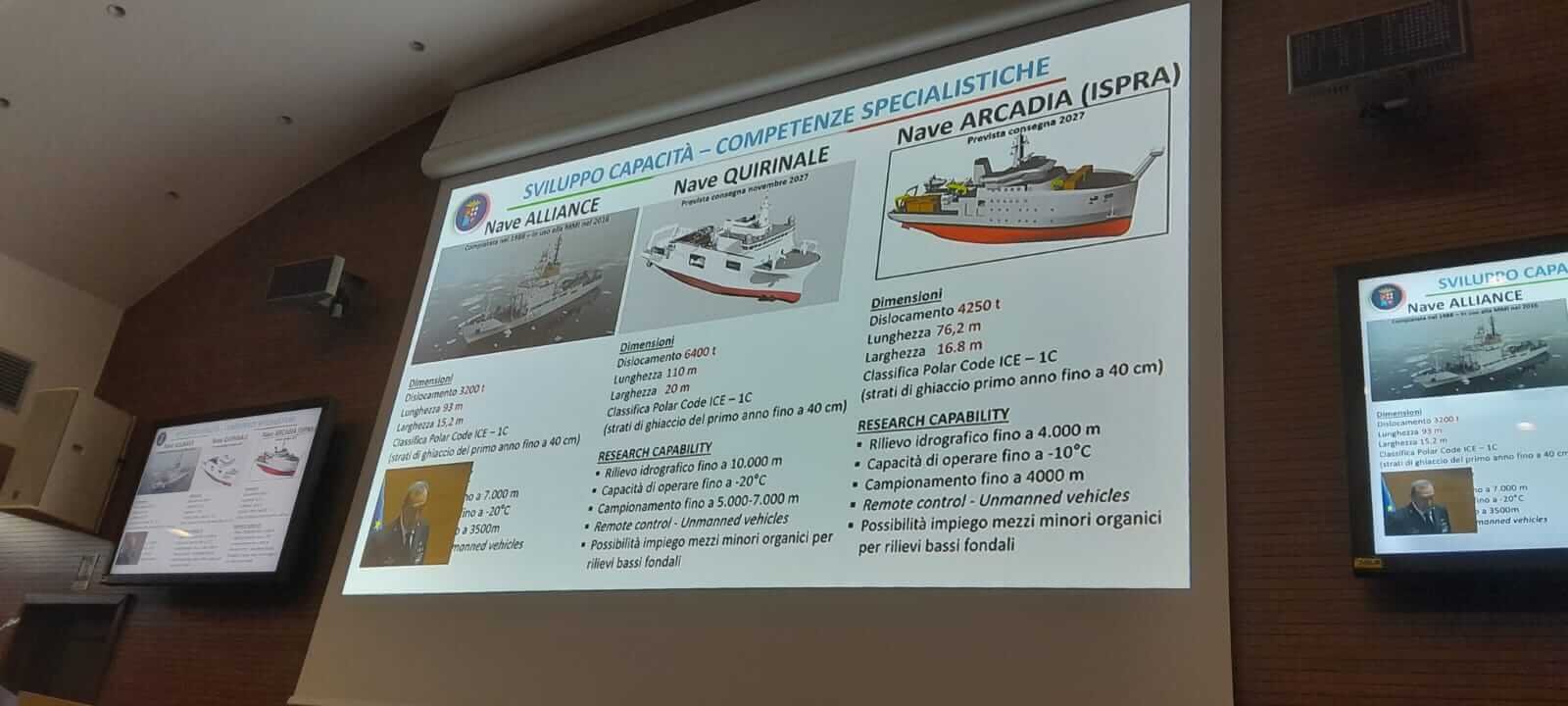
The Nave Alliance displaces just under 3,200 tons, is 93 meters long and 15.20 meters wide.
The ship is manned by a crew of 44 sailors and 20 researchers or other staff.
The diesel-electric propulsion of Nave Alliance is entrusted to two silenced diesel engines, a gas turbine, and two electric motors to which are added three diesel generators, with a total power of 24,090 KW and a top speed of 16 knots with a range of 7,200 miles.
The ship is one of the quietest of its kind, as it was designed to achieve a minimum level of sound propagation in water.
The unit has been employed by the Navy, under the scientific coordination of the Hydrographic Institute, for the marine geophysics campaigns of the High North research program.
The ship, able to operate with first-year ice layers up to 40 cm in thickness, can carry out hydrographic surveys up to 7,000 meters deep, operating in external temperatures down to -20°, using unmanned remotely controlled vehicles, with sampling capabilities up to 3,500 meters.
From Nave Alliance to Nave Quirinale
Moreover, for the replacement of Nave Magnaghi which has been serving for fifty years, the Navy has initiated construction of the Nave Idro-Oceanografica Maggiore at the Fincantieri shipyard in Riva Trigoso, called “Quirinale”, which will be delivered in November 2027.

Nave Quirinale will have a displacement of 6,400 tons, a length of 110 meters and a width of 20 meters; the propulsion architecture will be fully integrated electrical to reduce emissions; the ship will reach a maximum speed of 15 knots and will have a range of 7,000 miles at 12 knots.
It too will be able to operate with first-year ice layers up to 40 cm thick, can carry out hydrographic surveys up to 10,000 meters deep, operating in outside temperatures down to -20°, using unmanned remotely controlled vehicles (ROV) but also autonomous (AUV), with sampling capabilities from 5,000 to 7,000 meters, and can carry out shallow water Survey with two minor naval vessels on board.
The unit will be able to perform bathymetric, topographic and geodetic surveys, acquire hydro-oceanographic and marine geophysical data and meteorological data, as well as carry out magnetic anomaly surveys and conduct activities to support Rapid Environmental Assessment (REA) operations.
Unlike the Nave Alliance, thanks to the high-tech instrumentation that it will be equipped with and the technical solutions adopted, the Nave Quirinale will be able to operate indifferently at the North Pole and at the South Pole, having been specifically designed to operate in the planet’s extreme environments.
The crew will consist of about 80 sailors and up to 35 researchers can be added.
Nave Arcadia
The third ship of interest will be Nave Arcadia of the Higher Institute for Environmental Protection and Research (ISPRA).

In 2021, with the signing of the protocol of understanding between the Ministry of Ecological Transition (MiTe), Defense (represented by the Navy General Staff and the Directorate of Naval Armaments – NAVARM) and ISPRA, the design and construction of the new multipurpose naval unit was initiated, which will be available to ISPRA for scientific and environmental research activities in the Mediterranean and beyond, and in particular for monitoring the seabed and marine habitats.
The Nave Arcadia will also be tasked with monitoring the seabed for the installation and maintenance of cables, pipes, and undersea data and electrical transmission lines, as well as for undersea infrastructure and facilities for the production of energy from renewable sources, all strategic infrastructure for the country.
Nave Arcadia, ISPRA’S first NOMR (Major Oceanographic Research Ship), will be completed by the T. Mariotti Shipyard in the summer of next year and delivered in 2027, it will have a displacement of 4,250 tons, a length of 76.2 meters and a width of 16.8 meters.
The unit has been designed to study, monitor, and protect the Mediterranean marine ecosystems but also has characteristics that allow it to operate in the Arctic region at certain times of the year.
The propulsion of Nave Arcadia will be hybrid diesel-electric, with a quiet/silent class certification; the unit will be able to host 20 technicians/researchers and 20 crew members and will have a range of thirty days.
The ship, able to operate with first-year ice layers up to 40 cm in thickness, can carry out hydrographic surveys up to 4,000 meters deep, operating in external temperatures down to -10°, using unmanned remotely controlled vehicles (ROV) but also autonomous (AUV) able to operate down to 3,000 meters deep with 60 hours of autonomy, with a sampling capacity up to 4,000 meters. It can also survey shallow waters using the two minor ships on board, of which it has electric propulsion.