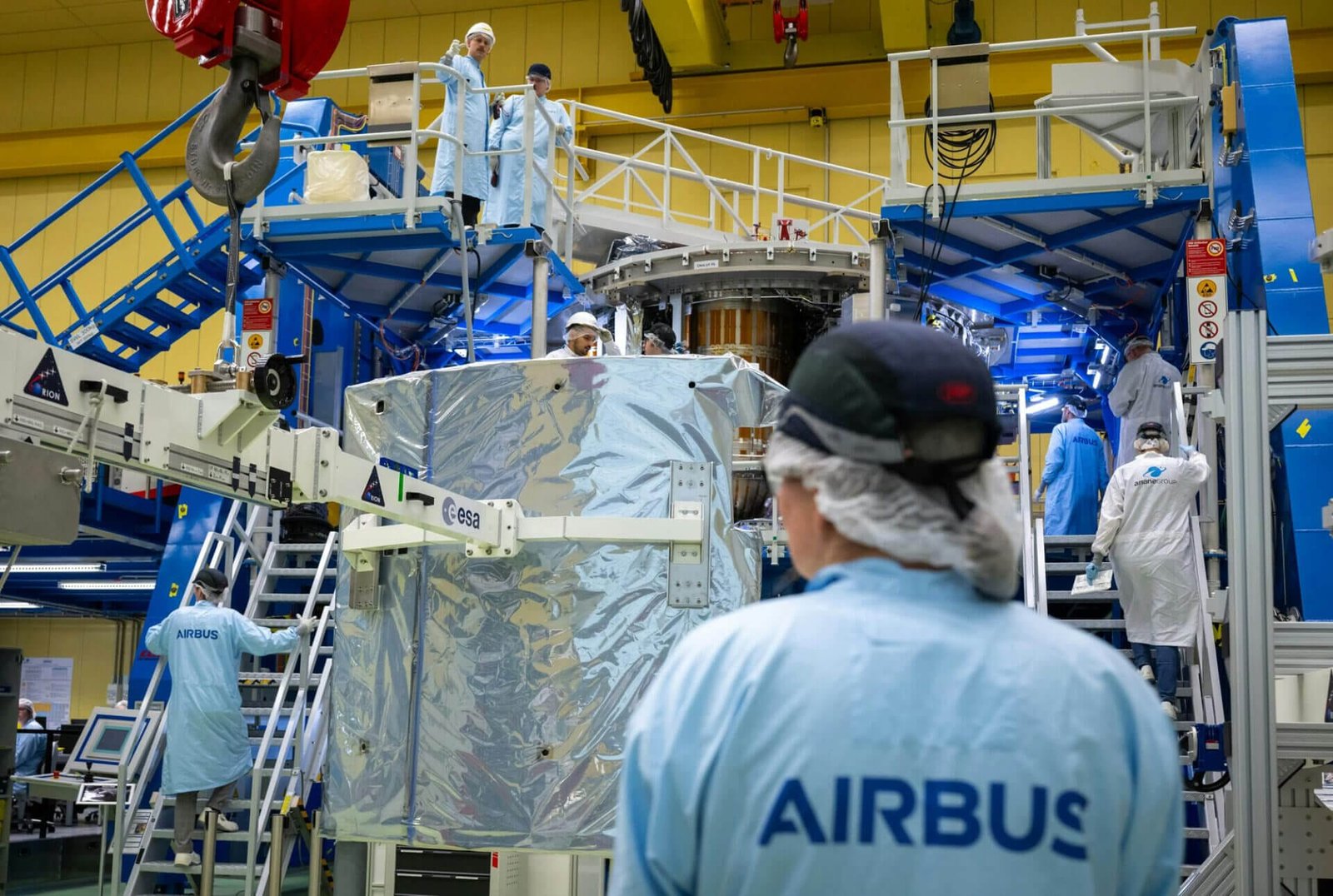
The fourth European Service Module (ESM-4) is ready to leave the Airbus factories in Bremen, Germany, to be shipped to NASA’s Kennedy Space Center in Florida, USA.

Upon its arrival, it will be tested and integrated with the Orion Crew Module, ready for the next phase of NASA’s Artemis program.
The upcoming Artemis IV mission
Built by Airbus under contract from the European Space Agency (ESA), the ESM-4 will be a crucial part of the Artemis IV mission. The mission plans for astronauts to live and work in humanity’s first lunar space station, Gateway, which will open up new opportunities for science and preparation for human missions on Mars.
“_The delivery of the fourth ESM brings us a step closer to a new space age with a lunar space station and greater opportunities for deep space scientific research. Europe’s role, through the ESA, is crucial in this pioneering program led by NASA_”, said **Ralf Zimmermann**, **Head of Space Exploration at Airbus**.
“_ESM-4 will play a key role as the Artemis IV mission is set to deliver the Lunar Gateway’s International Habitation Module (Lunar I-Hab). This cutting-edge hardware, developed by Airbus Defence and Space and its subcontractors across Europe, demonstrates our ability to contribute to significant international partnerships_”, stated **Daniel Neuenschwander**, **Director of Human and Robotic Exploration at the ESA.**
ESM modules provide engines, power, thermal control, and provide astronauts with water and oxygen. The ESM is fitted beneath the crew module, and together they form the Orion spacecraft.
Thales Alenia Space Italia supplies the thermal control system to keep the Orion crew modules between 18 and 24 °C, radiating excess heat from the spacecraft, while also keeping the cold at bay.
Orion’s four solar panels generate 11.2 kW of electricity, enough to power two families of four on Earth. Only about 10% of the energy is needed for the ESM, while the remaining 90% is designated for the batteries and equipment of the crew module. The Artemis I mission has proven that the solar panels can produce slightly more energy than expected, and this extra energy will be useful for the evolution of the Artemis program.
The energy stored in the Crew Module’s batteries is crucial as it provides powers to the Orion spacecraft even when the Sun is obscured. The batteries also provide the energy for a safe return when the ESM separates from the crew module at the end of the mission.
To enable astronauts to focus on more important tasks, the ESM’s onboard electronics, controlled by the Crew Module, offers a high level of autonomy, such as temperature regulation and rotation of solar wings to track the Sun.
Orion has 33 engines onboard the ESM to provide thrust and maneuverability. The main engine, a repackaged Space Shuttle Orbital Maneuvering System Engine (OMS-E) supplied by NASA, generates 26.5 kilonewton of thrust. This provides enough force to escape Earth’s gravitational field and perform trans-lunar injection, as well as entering lunar orbit.
Eight auxiliary thrusters act as a backup for the OMS-E and for orbital corrections. There are also 24 smaller engines for attitude control in space, allowing the spacecraft to rotate or change its angle during docking maneuvers.
Source and photo credit @Airbus Defence and Space