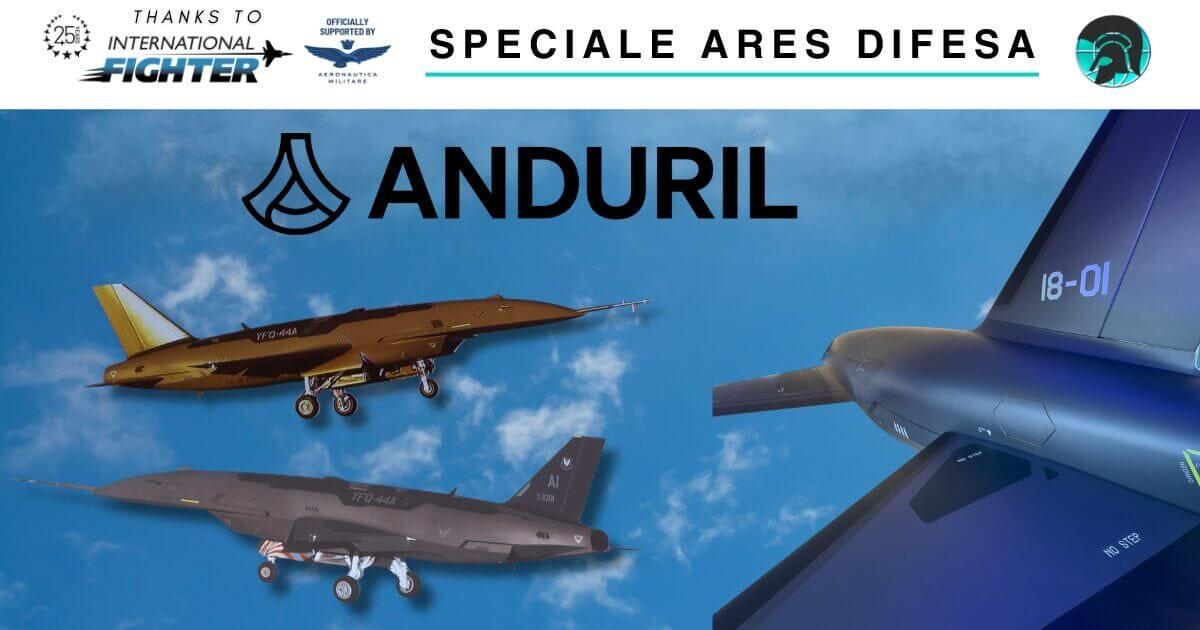
During the International Fighter Conference in Rome, the American company Anduril outlined a vision that goes beyond a single technology or aircraft. Anduril’s focus is on the entire ecosystem of contemporary air defense, increasingly characterized by continuous evolution, short development cycles, and deep integration between industry, software, and operational capabilities.
In recent years the sector’s landscape has changed rapidly. Actors like Shield AI, Helsing, and Anduril itself, absent just a few years ago, are reshaping the industrial map of aerial combat, introducing digital world dynamics into a sector historically dominated by large platforms and multi-decade programs.
**Beyond the centrality of the platform**

The traditional platform-centric approach, based on the idea that military superiority stems from the individual weapons system, is being replaced by a vision that’s system of systems, dynamic and adaptive.
The proposed analogy is that of the smartphone: the hardware remains recognizable over time, but what determines its real power is the evolution of software and the application infrastructure supporting it.
In the aerial domain, this transition translates into the need to abandon the logic of ‘generations’ of aircraft in favor of modular architectures, continually updatable, where supremacy is not given by the platform itself, but by the speed with which it can adapt to new operating contexts.
**Autonomy as a requirement, not a choice**

The growing complexity of the battlefield and the speed of threats impose a new form of balance between man and machine.
Autonomy, often perceived as a futuristic or controversial concept, is described here as a compulsory step: the information density and the simultaneity of actions will make it increasingly difficult to manually manage every tactical decision.
In this perspective, autonomy does not replace human control, but amplifies its capabilities, allowing for decision superiority in high-intensity scenarios.
The real challenge, according to Anduril, is cultural — it is necessary to overcome distrust and misunderstandings by better communicating opportunities, limitations, and the ethics of algorithmic control.
**From generational leaps to continuous evolution**
One of the most critical elements of the Western defense industrial model is the slowness of development cycles.
The civil sector, especially the digital one, evolves incrementally, releasing updates and continuous improvements. The military sector, on the other hand, proceeds through ‘generational leaps’, spaced out by years or even decades.
Anduril proposes to overturn this paradigm and aim for a constant flow of innovation, with rapid and scalable updates, both on the hardware and software level.
This implies a new way of designing: Anduril promotes the opportunity for born digital platforms, built from the outset to be updated over time, with interchangeable modules and distributed production logic.
The key is no longer absolute perfection, but the ability to ‘be good enough, immediately’, to then constantly improve performance through subsequent iterations.
**The advantage of private capital and controlled risk**
One of Anduril’s strengths is the typical approach of venture capital.
In a context where public programs tend towards caution, the Californian company can afford to explore emerging technologies while assuming targeted risks.
The key concept is calculated risk, betting in an informed way on potentially revolutionary capabilities, based on a deep understanding of the operational context and real needs.
This approach has already produced tangible results, enabling Anduril to quickly bring autonomous solutions and advanced sensor systems to market in collaboration with the US and allied Armed Forces.
**Industry and operators: the necessary symbiosis**
In conclusion, for Anduril, technological superiority today stems from direct cooperation between those who develop and those who employ weapon systems.
The continuous connection between industry and operators allows for drastically reduced development times, adapting requirements to field realities, and making mid-course corrections that, in the past, would have required years of revision and high costs.