
Introduction
Technological evolution is outpacing doctrine, and modern pilot training has become a battleground between the potential and limitations of the system. In the United States, where the training pipeline forms the backbone of aerial superiority, the Air Force is redesigning its model to adapt it to the digital age and the capabilities of fifth-generation combat aircraft.
For fifty years, from the aftermath of the Vietnam War, the axiom has remained unchanged: “train the way we plan to fight”, a principle, born in 1975, which has ensured American aerial supremacy for half a century. But today, it is reckoning with a radically different technological ecosystem.
From Analog Reality to Digital Domination
The real change is not only in the platforms, but in the minds of the pilots. After the era of “kilobytes”, humanity has entered the age of “terabytes”: a society where the volume of data and the speed at which it is generated, far outstrips human cognitive capacity.
The Air Force recognizes that the transition isn’t generational, but structural: those born before 2007 had to learn the digital language, those born after it speak it naturally.
This phenomenon also changes the way we learn. Analog reality, based on trust, direct experience, and relationships, coexists with the digital realm, where information and intelligence are shared instantaneously. In the military context, this dual dimension deeply influences training: training can no longer be based solely on maneuvers and procedures, but must integrate information management, decision-making speed, and situational awareness in digitally fused environments.
The Advent of the Fifth Generation

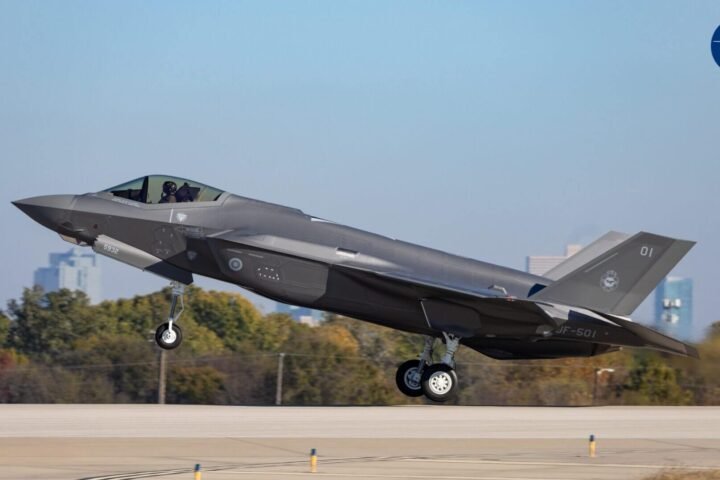
Since 2005, with the introduction of the F-22 and later the F-35, the Air Force has ushered in a new era. But if the United States had an initial ten-year advantage, rival powers, particularly China and to a lesser extent Russia, are rapidly closing the gap, leveraging technology sharing and the acceleration of industrial cycles.
The increase in lethality and range of weapon systems has shifted the decision-making center well beyond visual range: operational decisions are now made over 300 miles from the target. Combat “beyond sensor range” requires data fusion and electromagnetic domain management capabilities that no previous generation ever had to confront.
The Problem of Absorption and the Pipeline Crisis
The training system inherited from the past is no longer balanced. More pilots are produced than can be brought to full operational maturity. The traditional phases, from initial training on turboprop aircraft to operational conversion on fighters, have extended by several months, while the complexity of digital combat requires constantly updated skills.
The most evident limitation is physical: real training polygons, like the Nellis Range, are now too small compared to new threat scenarios. The entire operational space of 210 x 120 miles is “inside” the engagement area of a modern enemy anti-aircraft system. For this reason, advanced simulation has become the new frontier of preparation.
The Red Flag of the Future: The Synthesis of Real and Virtual
The modern equivalent of the legendary Red Flag exercise is no longer in the skies of Nevada, but in a connected and distributed synthetic environment: the Joint Synthetic Environment. Here it’s possible to train for the full spectrum of fifth generation capabilities without exposing sensitive tactics and procedures.
The key concept is “blended” training, a fusion of virtual reality and real flight. Projects like Project JUICE represents the first practical demonstration of this vision: the goal is to integrate augmented reality directly into the cockpit, turning each mission into a live and adaptive simulation.
Between 2026 and 2027, the Air Force will conduct the first system validations on T-38 and F-16 aircraft, with the prospect of extending it to fifth-generation fighters in the future. The goal is ambitious: to bring the simulation “behind the glass” of the instrumentation, connecting it to the aircraft’s real controls to generate virtual scenarios directly in flight.
The New Phase 4

Simultaneously, the training curriculum will be expedited: tactical skills that are today taught only in advanced phases (Phase 5 and 6) will be introduced already in Phase 4, in an experimental program of “Initial Tactical Training”. The idea is to transfer fundamental concepts of combat, radar signature management, electronic warfare, decision-making as early as possible so that pilots arrive at operational conversion with a solid foundation.
This approach, already named in Canada as Future Fighter Lead-In Training, aims to halve learning times and balance production and absorption: fewer flight hours on expensive operational fighters, more experience gathered on surrogate platforms, with configurable cockpits and tactical data links compatible with those of real aircraft.
Toward a New Cognitive Generation
The concept of a “fighter pilot” is not just a role anymore but a form of distributed intelligence. Today’s aviator manages amounts of data comparable to those of a squadron commander a few years ago. His training is becoming increasingly similar to that of a network operator: decisions in fractions of a second, sensor fusion, multi-domain awareness.
The future of aerial training will thus be defined by three keywords: integration, speed, and adaptability.
Immersive simulation, augmented reality, and artificial intelligence will become the tools to build the next generation of pilots.
So, half a century away from the motto “train the way we plan to fight”, the Air Force renews the principle but rewrites the language: train the way we adapt to fight. To train not just to fight, but to change, preferably faster than the enemy.