
Warehouse Security: Enhancing Product Protection with Appropriate Packaging
A warehouse is not a mere place for passive storage; it’s a dynamic environment, a crucial hub where goods are moved, sorted, and prepared for distribution. Particularly at this stage of rest and handling, the risk of product damage is extremely high.

A forklift bump, a fall during sorting, or a wrong stacking can turn a ready-for-sale product into a net loss even before transportation begins. Hence, investing in appropriate industrial packaging is not merely a precaution for shipping but the primary and fundamental form of insurance for goods’ integrity and the operational safety within the warehouse.
The Physical Protection: The First Line of Defense Against Damages
The primary function of packaging is to protect the content. In a warehouse, threats are constant and come from multiple directions: accidental impacts during movement with forklifts, vibrations during rollers’ movement, and, above all, the pressure resulting from stacking.

An undersized or inadequate packaging will collapse under weight, triggering a dangerous domino effect. Therefore, the choice must be based on a realistic risk assessment: materials with adequate cushioning capabilities (such as shaped interiors or fillers) for fragile products, and heavy cardboard boxes or wooden crates for those needing to withstand significant vertical loads.
The Pallet Stability: The Pillar of Safety
Most damages and incidents in a warehouse come from one sole cause: the loss of stability of the load unit. A poorly constructed or poorly secured pallet is a hazard not only to the goods but also to the operators. A pallet collapsing from a high rack can have dramatic consequences.

Warehouse safety is based on creating a load unit (the pallet) that is a single, compact, and stable block. To achieve this, it is not enough to stack the boxes; it is necessary for the outer wrap to tightly bind the goods to the pallet.

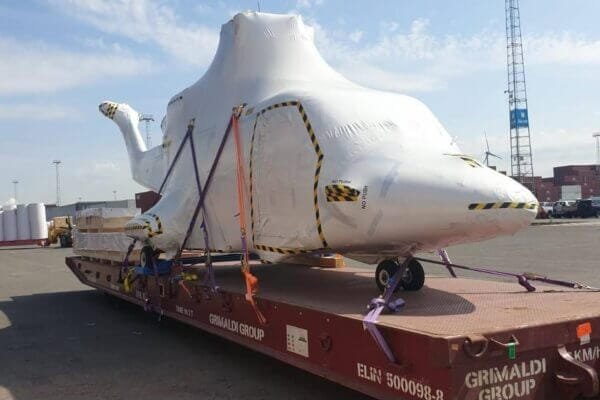
Solutions such as industrial shrink wrap packaging (caps) are designed for this purpose: by creating a ‘second skin’ robust around the entire load, it makes it stable, safe, and also protected from external agents like dust and moisture.
Advice for Improving Safety Through Packaging
To turn packaging into a safety ally, some practical rules often supported by consolidated standards (like EUMOS guidelines on load stability, designed for transport but also fundamental for storage).

Among them we could mention:
- Don’t skimp on primary packaging: using sturdy boxes, especially for products that will base the pallet, is essential to support the overhead weight;
- Optimize the palletization scheme: boxes should be arranged to interlock, avoiding leaving empty spaces and ensuring that the stack is vertical and does not protrude from the edges of the pallet;
- Secure the load to the pallet: the use of stretch film or for higher protection, industrial shrink wrap packaging, matters a lot. Wrapping should include the base of the pallet to ‘tie’ the load physically to the pallet, preventing slippages;
- Clear labeling: using handling labels (like ‘fragile’, ‘high’, or stack indicators) helps the operators handle the load with due caution.
Thus, warehouse packaging is not a cost to reduce, but a strategic investment. Proper packaging design drastically reduces costs deriving from breakages and returns, but above all, it increases the overall safety level, protecting the value of goods and the safety of personnel.
Materials and photos provided by Cocoon Industrial Packaging Ltd.