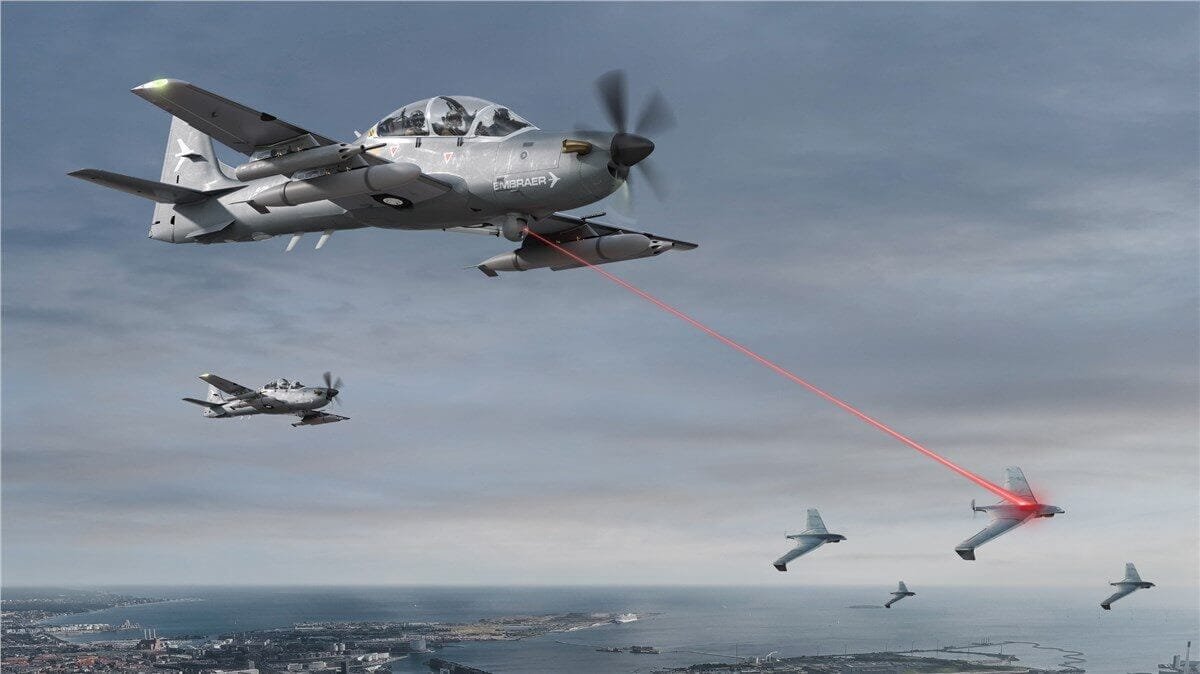
Embraer, a global leader in the aerospace industry, has announced that the A-29 Super Tucano is expanding its mission portfolio to effectively and affordably counter the modern threats of unmanned aircraft.

Building on the operational features of the A-29 and new sensors, including specific data links for the reception of initial target coordinates and queuing, the electro-optical/infrared (EO/IR) sensor for tracking and laser designating, as well as Semi-Active Laser (SAL) guided rockets and 12.7x99mm wing-mounted machine guns to neutralize engaged Unmanned Aircraft Systems (UAS), the operational concept (CONOPS) defined by Embraer will enable current and future A-29 operators to add anti-drone missions to their operational profiles whenever necessary.
The Super Tucano was designed for advanced training, armed reconnaissance and surveillance, close air support, and has evolved into a platform for ISTAR missions; today it also adds C-UAS capability made extremely relevant by the widespread use of UAS and loitering munitions demanding technologically and economically sustainable responses.
The A-29 Super Tucano is a low-cost multi-mission aircraft, equipped with cutting-edge technologies for precise target identification, weapons systems, and a full communication suite. Its capabilities are further enhanced by advanced avionic systems of human-machine interface (HMI) integrated into a robust airframe able to operate without need for particularly equipped infrastructures.
Furthermore, Embraer’s aircraft has reduced maintenance requirements and offers a high level of reliability, availability, and structural integrity with low life-cycle costs.
Source and image credits @Embraer