Introduction
The European consortium, Eurofighter, despite preparing to celebrate forty years since the establishment of the Eurofighter GmbH holding and the challenges faced during the first twenty years of activity, is more alive than ever and aiming to secure new contracts, both from countries already using their aircraft and by entering new significant markets.

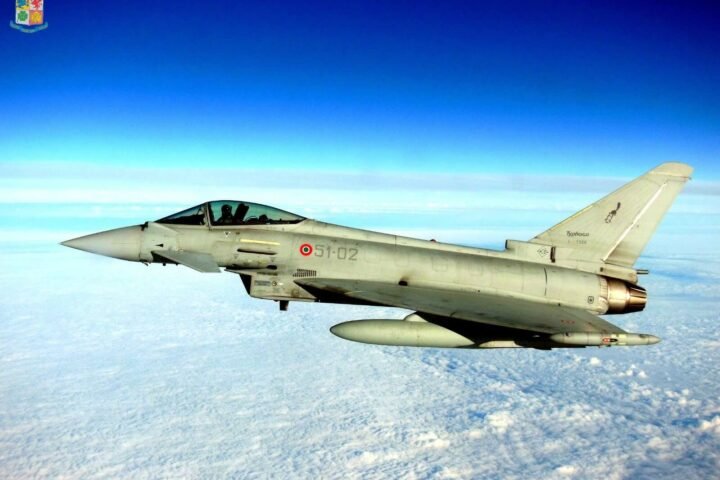
Presently, there are 581 Eurofighter fighter-bombers in service in 9 countries; the four nations that founded the consortium, Germany, Italy, United Kingdom, and Spain, Austria, Saudi Arabia, Kuwait, Oman, and Qatar.
Models in Production
The Eurofighter consortium, which includes Airbus Defence and Space with factories in Germany and Spain, BAE Systems in the UK, and Leonardo in Italy, currently has 67 models, of which 38 are for Germany (Quadriga programme), 20 for Spain (Halcon 1 programme), seven for Kuwait and two for Qatar.

The models for Kuwait and Qatar are from the Tranche 3+ as they are essentially 3A’s fitted with the E-SCAN ECRS Mk 0 radar, an electronic scanning variant of Captor developed by Leonardo in collaboration with BAE Systems and the Air Force that oversaw its testing, and the upgraded Praetorian Defensive Aids Sub Systems (DASS) for electronic protection.
The aircraft for the Luftwaffe and the Ejército del Aire y de l’Espacio will be Tranche 4s equipped with the ECRS Mk 1 radar developed by Hensoldt and Indra, with additional new systems. They are intended to replace the German Tranche 1s and some of the Spanish EF-18 Hornets.
New Orders in 2024-2025
In the last biennium, the Eurofighter consortium has shown great vitality by securing orders for 89 new aircraft, including 25 from Spain, 24 from Italy, 20 from Germany, and 20 from Turkey, a new client for the fighter-bomber.

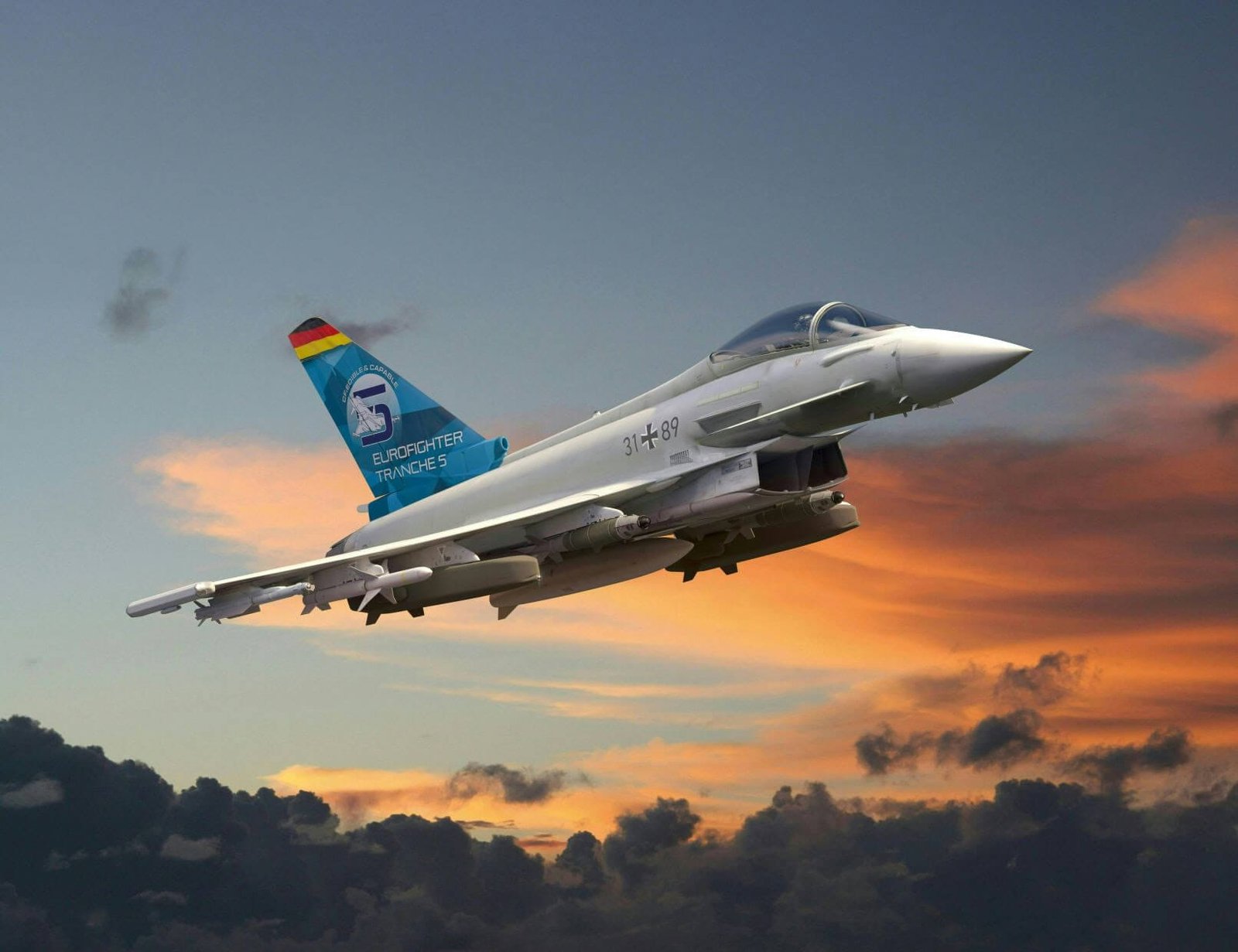
For Germany, the new aircraft will be from Tranche 5, and it’s likely that the Spanish aircraft will be of the same type since they are essentially similar and will be equipped by Airbus in both Germany and Spain.
The situation is slightly different for Italy; they are discussing Tranche 4 aircraft equipped with Leonardo’s ECRS Mk 0 with possible adoption of the ECRS Mk 2, in development by Leonardo UK. The new models will replace the Tranche 1s at the end of their operational life with limited capabilities in service with the Air Force.
Turkey: New Production and Second-Hand Aircraft
For Turkey, on the other hand, the timescales are longer, and the aircraft that will be assembled by the BAE Systems production line will be equipped with the ECRS Mk 2 radar from the outset.

Additionally, Turkey aims to acquire twelve Eurofighters from Qatar, practically newly manufactured by BAE Systems with few flight hours, to start operating with this aircraft while waiting to receive the new production aircraft from the United Kingdom.
Furthermore, Ankara has started similar negotiations with Oman, which, however, has Eurofighters equipped with Captor-M mechanical scanning radar and not electronic.
Potential for 134 New Aircraft
However, as anticipated, the Eurofighter consortium is aiming to secure new contracts, estimating the possibility of receiving orders for another 134 aircraft.
Of these, 12 would be those purchased by Qatar to replace the units currently being transferred to Turkey and 54 for Saudi Arabia, which is looking to renew its line of heavily-used Eurofighters in combat over Yemen.
The remaining new craft would be ordered by Austria and Poland.
Austria Aims to Double Eurofighter
The significant developments would be represented by 36 models that would interest Austria, which currently has 15 Tranche 1 Block 5 Eurofighters with limitations in weapons capabilities, recently integrated by a couple of Eurofighter twin-seaters from Tranche 1 handed over from the German Luftwaffe to the Austrian Air Force, and the 32 models that the consortium aims to sell to Poland, making it a new user country of the European fighter.

For Austria, the potential order of 36 new production Eurofighters would represent a real qualitative leap, effectively doubling the fleet by providing it with state-of-the-art aircraft without limitations on weaponry, with Iris-T and Meteor BVR. These aircraft would join the 12 M-346FAs, the “light” combat and advanced training variant of the Italian aircraft, recently ordered from Leonardo.
Therefore, if this order were to go ahead, which in any case requires an increase in pilots, technical staff, the upgrade of air bases and the establishment of adequate weapons stocks, the criticisms with Airbus that marked the purchase of the first Eurofighters would be totally and definitely archived. The war triggered by Russia against Ukraine and the new stance adopted by the United States with Europe has led to a total change in pace in Vienna’s military policy, increasing defense expenditures to modernize and strengthen the Armed Forces faced with an unforeseen scenario of a possible large-scale European conflict and an unpredictable US disengagement from Europe and new relations with NATO of which Austria is not a member but a partner.
Poland as a New Potential User
The other order considered possible by the consortium concerns Poland, which has a requirement for 32 air superiority fighters; the European aircraft is mainly in competition with the F-15EX, which Boeing is heavily supporting in order to secure the coveted order.

Moreover, it should be noted that Poland, which has initiated a massive rearmament plan over these years involving all three armed forces, has requested over 40 billion euros in loans from SAFE and is the country with the largest requested quota among the 19 EU countries plus Canada that have decided to join this form of subsidised finance for the purchase of certain weapons systems and equipment, including those for air defense; these purchases will be made possible with the contribution of the Commission to stimulate the European military industry sector.
The enormous sum requested by Poland, which in any case will have to be examined by the Commission and authorized by the Council of Europe (a procedure that applies to all countries that have joined SAFE) could favor the Eurofighter consortium. Poland is represented by Leonardo, which is heavily present there with helicopters, training aircraft and ground equipment, with its production facilities which also assure maintenance and support.
It is no secret that the consortium has offered Poland extensive industrial participation in the order and a role in the program as a component supplier. For Warsaw, one of the key requirements is the expansion of its industrial base, securing significant workloads, increasing and sustaining the workforce, and promoting the technological development of the defense-related industrial sector.
Other Opportunities for the Eurofighter Consortium
It should also be remembered that Airbus, as part of the Eurofighter consortium, is developing a version of the Eurofighter for electronic warfare and the suppression of enemy air defenses, the Eurofighter EK, which is currently adopted by the Luftwaffe in 15 examples to replace some of the current Tornado ECR DE in service.

New orders from Germany and Spain for additional Eurofighter Tranche 5s to replace, respectively, the last Tornado IDS and EF-18 Hornets still in service should not be ruled out, and discussions with Turkey, which appears interested in increasing the number of aircraft at its disposal, are ongoing.
In conclusion, for an aircraft that has not exactly straightforward industrial choices (four production lines, development of three versions of the same E-SCAN radar), the results obtained and those forthcoming are excellent, considering that it is a high-performance combat aircraft that can only be purchased and maintained by countries with economic capabilities and high-profile air forces.