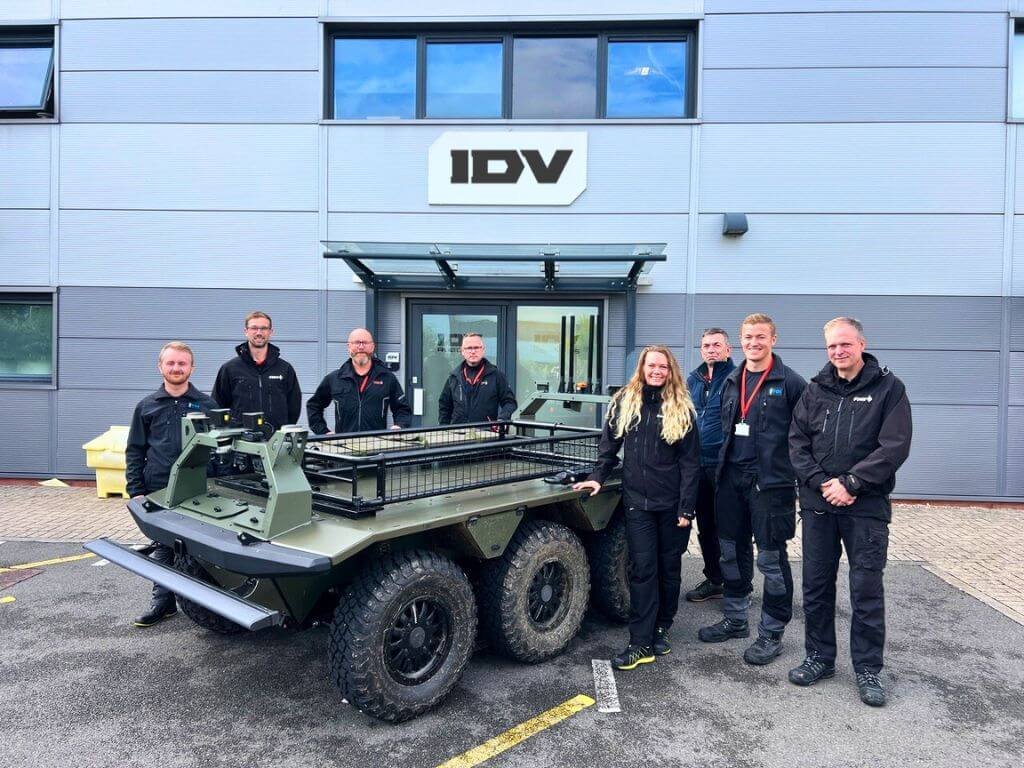
IDV Viking: Sweden Begins Trials of Next-Gen Autonomous Land Vehicle
IDV (Iveco Defence Vehicles) has announced that its unmanned ground vehicle, VIKING, will be tested by the Swedish Defence Materiel Administration (FMV) as part of the Autonomous Multifunctional Ground Vehicle Demonstrator Programme.
This initiative marks a significant step in the operational evaluation of the vehicle, which in recent months has successfully participated in international exercises such as “Stella Alpina” in Italy, and the AUKUS TORVICE trials conducted among the United Kingdom, United States, and Australia.

The VIKING is one of the most advanced projects in the European landscape of autonomous ground systems. It is a 6×6 vehicle with plug-in hybrid diesel propulsion, designed to offer maximum flexibility in modern military operations.
The ability to operate for about 20 kilometers in a fully electric mode, coupled with a particularly contained acoustic and thermal footprint, constitutes a decisive tactical advantage in contested scenarios or in missions requiring discreet presence.
The total range, which exceeds 200 kilometers thanks to the hybrid configuration, allows extended deployments to support advanced columns, reconnaissance units, or specialized teams.
Another distinctive feature is the ability to transport loads up to 750 kilograms, a characteristic that significantly broadens the possible operational roles: transportation of materials, evacuation of wounded, use as a sensory platform, or carrier of low-profile weapon systems.

Defining the performance of the VIKING is also the MACE system, the autonomous control architecture developed by IDV, which integrates functions of mobility management, route planning, and remote supervision. The system takes advantage of the ATLAS navigation engine based on artificial intelligence, a feature that allows the vehicle to move reliably even in conditions of GNSS signal denial, ensuring operational continuity in complex and degraded scenarios.

The program initiated by the Swedish authorities will serve to evaluate the effectiveness of unmanned platforms in assuming diversified roles, understanding their interaction with manned assets, and verifying their operational contribution in countering emerging autonomous threats, including those from the air domain, such as drones and micro-UAS.
Sweden, engaged in a significant strengthening of ground defense capabilities, is particularly interested in solutions able to increase personnel protection in high-intensity operations, and boost logistical resilience, key elements in the context of European and NATO military transformation.