In the global landscape of military training, Italy has established itself in recent years as one of the most advanced hubs in fighter pilot training.
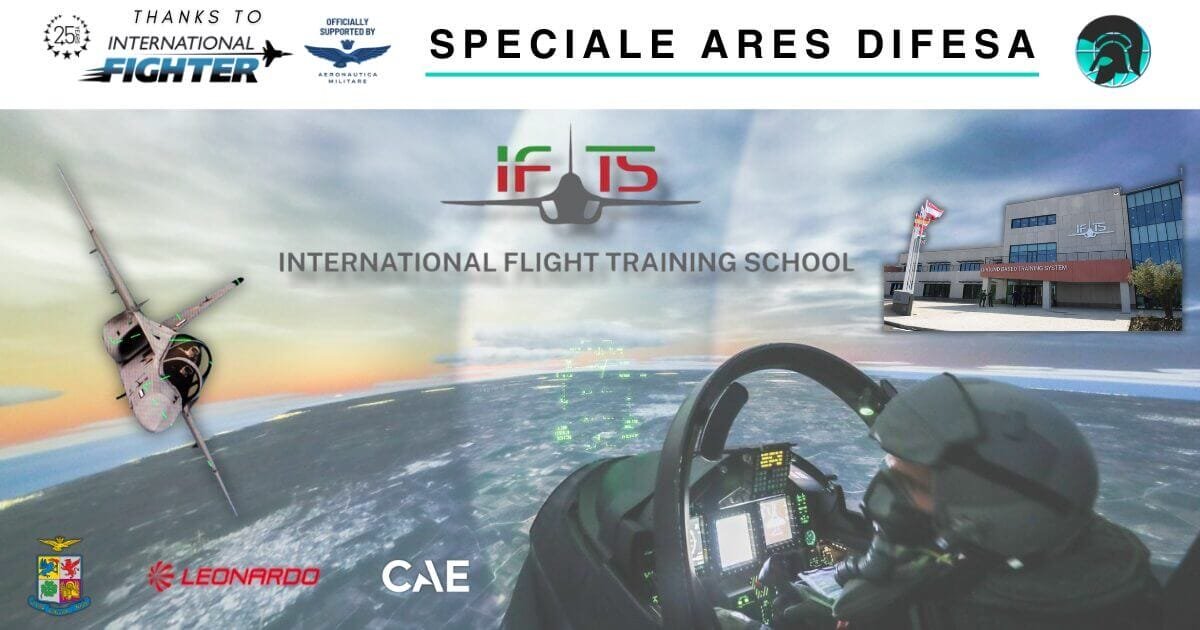
The project of the International Flight Training School (IFTS), a collaboration between Military Aviation and Leonardo, with the support of CAE and numerous industrial partners, represents an international reference model.
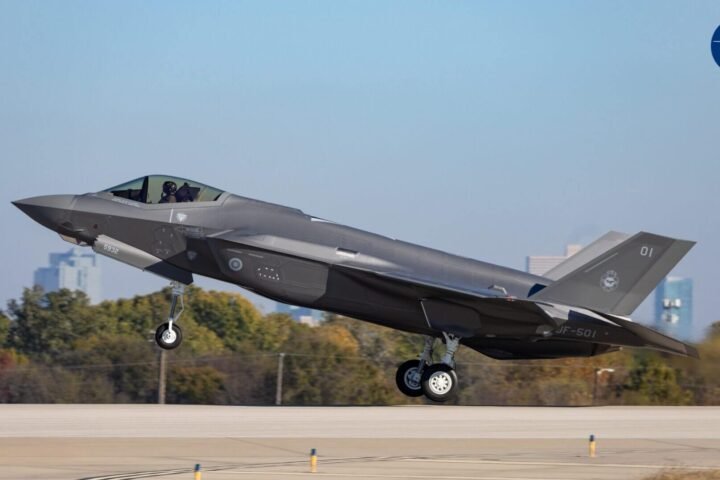
Its mission, outlined during the International Fighter Conference, is clear: to provide a complete, technologically integrated training entirely focused on the new generation of combat aircraft, from the Eurofighter Typhoon to the F-35, and in perspective, the Sixth Generation platforms like the GCAP.
From the Roots of Change to the Birth of the IFTS

The transformation of the Military Aviation training system originated in the mid-2010s, coinciding with the receipt of the first F-35A Lightning II at the Amendola base. Similarly, the Eurofighter community was evolving from an exclusively air-to-air role to a multirole profile, while the gradual phase-out of the Panavia Tornado fleet was being prepared.
From operational units, there grew an awareness that the training of new pilots was no longer adequate for the complexity and missions of modern combat aircraft.
In legacy aircraft, the pilot’s attention was mostly focused on conducting the aircraft and secondarily on completing the mission. The complexity of modern scenarios and the technical evolution of aircraft, however, have reversed this perspective. The pilot is aided in controlling the aircraft thanks to the advanced tools at his disposal. Still, the context in which he operates and the threats he must confront require the execution in short times of a complicated sequence of operations, as well as the need to integrate data coming from many different sources.
Therefore, Military Aviation decided to revolutionize its training pipeline, introducing a fourth phase of training, focused on preparing for multirole combat, and began searching for a new integrated system capable of bridging the gap between school and the operational department.
An Integrated Training System

The heart of the IFTS is the M-346 Master, developed by Leonardo, an advanced trainer with superior performance and avionics, designed to realistically replicate modern fourth and fifth-generation fighters. However, the innovation doesn’t only lie in the air platform but in the Integrated Training System (ITS) that surrounds it.
This ecosystem includes a series of on-ground and in-flight tools that allow replicating many dynamic and complex situations that, until a few years ago, could be performed more restrictively.
The advanced multi-level simulation, up to the Full Mission Simulator (FMS), includes LVC (Live Virtual Constructive) connections that allow the interaction between real and virtual pilots, hence, allowing to operate in complex contexts by simulating the execution of real missions.
In contrast, the Embedded Tactical Training System (ETTS) is an electronic system installed on board the aircraft that simulates radar, sensors, and weapons, eliminating the need for physical components and drastically reducing costs and maintenance. This system allows each aircraft to simulate the main equipment adapting to various mission profiles even if they are not physically installed. The pilot will still get real feedback, as if the plane were actually equipped with that particular sensor or weapon.
Additionally, in terms of mission programming, the Mission Planning and Debriefing System (MPDS) of new generation allows real-time monitoring and analysis of flight parameters that can be later examined during the post-flight or debriefing phase to research the pilot’s conduct and identify any issues.
Of secondary importance is the process that the pilot must undertake for training. A system equipped with artificial intelligence is capable of analyzing the student’s performance, verifying whether they are in line or below what is required. Therefore, the syllabus becomes dynamic and interconnected with the pilot’s experience, adjusting based on the student’s performance.
The result is a military-driven, industry-powered system in which the operational requirements are set by the Military Aviation, while the management of maintenance, simulation, and logistics is entrusted to the industry, with Leonardo responsible for airworthiness and CAE in charge of the simulation infrastructure.
This entire process relies on an open architecture that allows for constant updates and the integration of new technologies to allow for the evolution of training in step with the aircraft in service with the Italian and foreign armed forces, as well as to adapt it to recognized threats.
The Training Pipeline: Modular and Interoperable Excellence
The journey of a student pilot initially involves selection and basic training on SIAI-Marchetti T-260B propeller aircraft, followed by the stages on jets at Galatina in Puglia, and now mainly, at the new campus in Decimomannu, in Sardinia.
The site, extending over 130,000 sqm, includes 35,000 sqm of indoor infrastructure, with simulators, classrooms, mission centers, and logistical support areas. To date, there are 400 employees, including military and civilian personnel, working annually, with strong involvement from the local community that can access highly qualified job opportunities.

Since becoming operational in July 2022, IFTS has achieved significant results with over 16,000 actual flight hours and an equivalent number of simulated hours, almost 60 students trained simultaneously, for a total of 130 pilots trained to date, 14 participating countries, including the United States and Croatia, with 70% of students coming from partner countries.
The IFTS has a total of 28 M-346 aircraft, 18 of which belong to the Military Aviation, 4 to Leonardo, and 6 to the Qatar Emiri Air Force reserved for training Qatari pilots.
Technology and Sustainability as Efficiency Multipliers
The integrated approach allows a reduction in operational costs compared to traditional combat aircraft, saving many training activities previously carried out operationally.
The ETTS system, by eliminating radar and real components, guarantees reliability and lower emissions, while advanced simulation allows unlimited repeatability of missions without environmental impact.
According to the feedback from operational units, the quality of pilots trained at IFTS is significantly superior, with multi-role capabilities consolidated before moving on to the Operational Conversion Units (OCU), that is, that stage of training in which the pilot transitions to the aircraft assigned to the department assigned to him.
Towards the Future

The IFTS doesn’t stop given the constant evolution of the operational sector. The next evolutions involve the adoption of a Large Area Display to align the M-346 interface with that of F-35 and Eurofighter, biometric and physiological monitoring, for real-time evaluation of the cognitive and physical performance of pilots, mixed and augmented reality in simulators and real flights, expanding the LVC experience, and finally an integrated multi-domain training, extended to ISR, EW, and missions with joint assets.
In perspective, the system will form the basis for training future pilots of the GCAP (Global Combat Air Programme), ensuring interoperability with allied platforms and full compatibility with European and NATO simulation networks.
A Strategic Center for Global Training

With the IFTS, Italy has transformed a national need into an international strategic opportunity, offering a service of excellence to partner countries as well.
The training-as-a-service model, public-private, scalable, and technologically advanced, consolidates the role of Military Aviation and the national industry at the heart of the western defense system.
The Military Aviation retains control over the course content, standardization, tests and exams, ground and flight training, as well as the selection of military and civilian instructors.
The industry, with Leonardo providing the integrated training system and the Canadian CAE the simulation systems, is responsible for the infrastructural part, the logistical support of the T-346, and the ground training system.
Today, the IFTS is a laboratory of integration between man, machine, and technology, capable of preparing pilots for the challenges of 21st-century aerial combat.