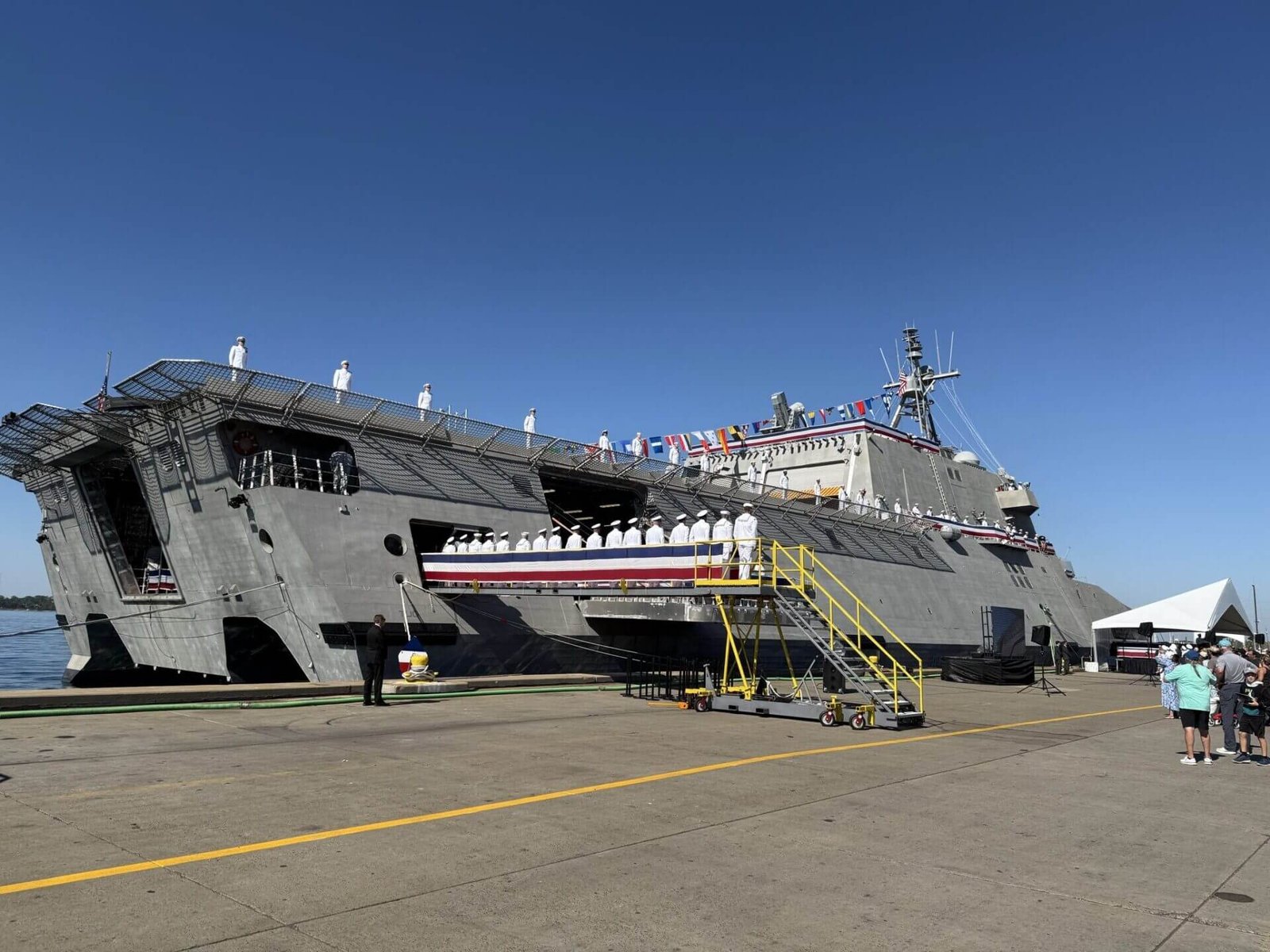
The Littoral Combat Ship USS Pierre (LCS 38), the nineteenth and final unit of the Independence class, was officially put into service by the US Navy on November 15 in Panama City, Florida.

Characteristics of Independence-class LCS
The Independence class built by Austal USA displaces 3,100 tons at full load, has a length of 127.4 meters, overall width of 31.6 meters, and draft of 4.3 meters; the maximum speed is around 44 knots, and the range reaches 4,300 nautical miles at 18 knots of cruising; the crew consists of 43 men to which up to an additional 35 people can be added for mission requirements.
This class of LCS adopts a CODOG (Combined Diesel or Gas) architecture based on two General Electric LM2500 gas turbines and two MTU Friedrichshafen 20V8000 series diesel engines that work on two lightweight multi-section carbon fiber propulsion shafts VULKAN connected to two Wärtsilä LJ160E waterjets and two LJ150E waterjets; in addition, there are two retractable azimuth thrusters at the bow.
The ships are equipped with four diesel generators that serve to produce the necessary electrical energy to operate the systems.
Weaponry of Independence-class LCS
The armament of the Independence-class LCS consists of a 57 mm Mk 110 gun and a CIWS Mk.15 Mod.31 SeaRAM for RIM-116 Rolling Airframe Missiles (RAM), as well as four heavy M2 12.7 × 99 mm machine guns used for close defense.
Depending on mission requirements, various mission modules can be added, alternately consisting of a pair of Bushmaster II Mk 44 30mm guns, RIM-162 ESSM missiles in the VLS module (thirty-two missiles), anti-ship RGM-84 Harpoon SSM (eight missiles) or RGM-184A Naval Strike Missile – NSM (eight missiles), or AGM-114 Longbow Hellfire Missiles (twenty-four missiles), devices for mine detection and clearance, as well as towed sonar curtains for submarine discovery.
Equipment of Independence-class LCS
The Independence-class units are equipped with a flight deck and hangar sized to operate with 1 MH-60R/S Seahawk helicopter and 1-2 MQ-8B/ MQ-8C Fire Scout UAS.
The electronic suite consists of a SAAB AN/SPS-77(V)1 Sea GIRAFFE 3D search and surface radar, a Sperry Marine BridgeMaster E navigation radar, an N/KAX-2 electro-optical sensor with daytime TV and FLIR camera, the Northrop Grumman ICMS (Integrated Combat Management System), and the ITT Corporation ES-3601 and BAE Systems NULKA ESM systems.
Photo credit @US Navy