USMC Selects Damen LST-100 for Landing Ship Medium Program
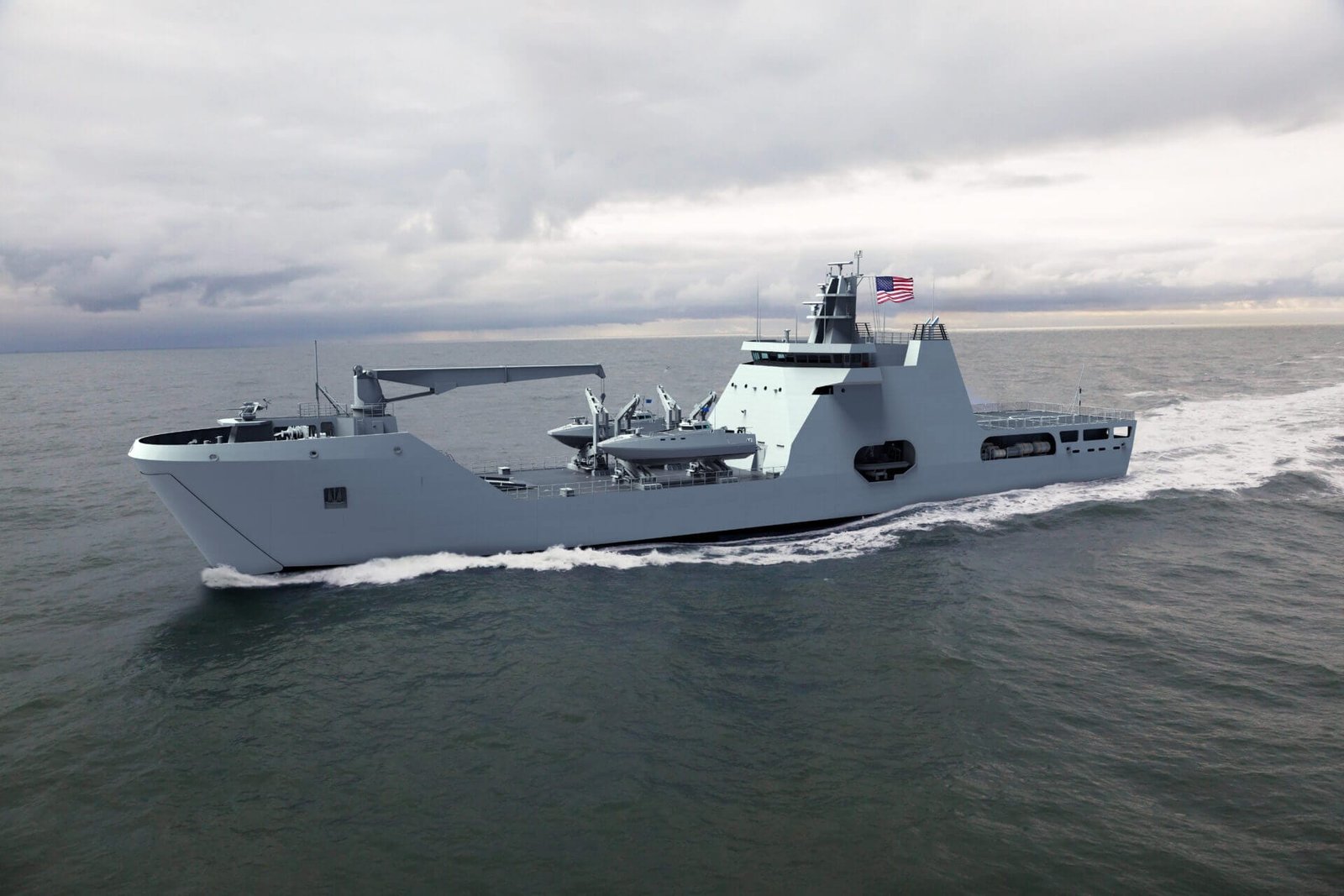
The Secretary of the American Navy (SECNAV) John C. Phelan, along with the Commander of the Marine Corps General Eric Smith, and Chief of Naval Operations of the US Navy Admiral Daryl Caudle, announced on December 3 that they have chosen the LST-100 transport and landing unit designed by Dutch shipyard Damen for their new Landing Ship Medium (LSM) class platform program.
The announcement was made through a video posted on social media. The SECNAV talked about the recent launch of an unprecedented transformation in how the US Navy will build and commission new naval units. According to him, choosing a project for the new LSM units as a crucial second step. He described it as “_driven by operational needs that responds to the availability of funds, injecting capability into the fleet with a responsible schedule_.”
“_For the Marine Corps, the LSM will provide an organic capacity for littoral mobility in the Indo-Pacific and the rest of the world. It offers us a crucial resource for intra-theater maneuver, capable of embarking, transporting, and landing Marines, weapons, supplies, and equipment in the operational theater without requiring access to a dock_,” General Eric Smith continued.
“_A year ago, the Navy canceled the competition for the LSM_,” said Admiral Caudle, when the project, designed according to the requirements of the Armed Force, had produced bids that were simply unsustainable. “_So we applied common sense, we went back to basics, and re-evaluated the program. We identified proven, existing designs that meet the requirements of the Commander of the Marine Corps, then we analyzed them from the point of view of producibility, performance and trade-offs_,” emphasized the head of the US Navy.
“_Last month_,” SECNAV concluded, “_with the approval of the Commander of the Marine Corps and the Chief of Naval Operations, I approved the selection of the LSM project: the LST-100 transport and landing platform, a ship of about 4,000 tons with a range of over 3,400 nautical miles, which gives us the right balance between capability, economy, and rapidity of introduction_.”
Transition from Light Amphibious Warship to LSM Block 1
After a long and tortuous journey of the program initially known as the Light Amphibious Warship (LAW) launched in 2020, the design selection process for the construction of the LSM Block 1 units concluded with the choice of the LST-100 project from the Dutch shipyard Damen.
As highlighted by Admiral Caudle, the US Navy originally launched the program to develop and build a project based on its own requirements. However, it was abandoned in December 2024 when the industrial proposals submitted to the Naval Sea Systems Command (NAVSEA) – the Navy department responsible for the research, development, design, construction, delivery, and in-service maintenance of naval units and related combat systems, exceeded the budget allocated for the program.
NAVSEA then pursued an acquisition strategy based on an accelerated process focused on an existing project in the market. Recordings show, the strategy would save significantly on costs and timing due to the project’s inherent maturity, eliminating the risks and developmental costs associated with an entirely new project.
Based on the Request for Information (RFI) launched in January 2025, a selection process was initiated. The process led to the decision to choose between the project derived from that of the type units ILSV (Israeli Logistic Support Vessel), based on that of the class units Frank S.Besson of the US Army, of which Bollinger shipyards built two sister units delivered to the Israeli Navy between 2023 and 2024, and the LST-100 project of Damen shipyard.
The latter was already chosen by the Nigerian Navy, which has the unit LST Kada delivered in 2021 in service, while in November 2024, the Australian shipyards Austal announced that the Australian Government had chosen the same Damen project for the program concerning the production of eight Landing Craft Heavy or LST type units for transport and landing of heavy materials and means, including tanks. The program expects the construction of the first unit to start in 2026.
In the meantime, with a contract worth $3.3 million awarded last July to the Dutch shipyard Damen, the American Defense through NAVSEA purchased from the Dutch shipyard a Technical Data Package (TDP), and a manufacturing license so that it could proceed as quickly as possible to the assignment of contracts for the supply of LSM-type naval units.
The same type of contract was signed in parallel with Bollinger for the ILSV project that was not eventually selected. NAVSEA, as in programs that see the choice of a development-complete naval unit, is contracting with Damen a package of design assistance and engineering support for the new units set to be built by a third party shipyard.
Construction Program
Simultaneously, on last September 26, the contract worth $9.5 million for the advance procurement of the main materials or “long lead time material” and associated engineering activities in support of the LSM Block 1 lead unit, LSM Block 1, was selected and awarded was awarded to Bollinger shipyards in Pascagoula, Mississippi. It will be named the USS McClung (LSM-1), regardless of the project that would be selected. The completion of the units subsequent, and in particular according to planning, of the next eight out of a total of at least 35 (although all documents speak of 18-35 units), as stated by the Commander of the Marine Corps, will be completed thanks to the work of what has been defined as VCM (Vessel Construction Manager), essentially a qualified and experienced company that can provide services and support for the construction of new units.
In particular, this entity will have to support NAVSEA and the US Navy in awarding contracts for the construction of more LSM ships, providing supervision and management of all aspects related to construction, including planning, programming, cost control, and quality, monitoring the performance of shipyards according to contractual requirements and reporting to the Government the progress of production and metrics, providing technical expertise and advice to shipyards, and finally managing the configurations of the ship project within multiple successful shipyards. The competition for the award of this contract is still to be launched in 2026.
According to preliminary information released by NAVSEA, the expected period for the construction of each ship is 32–36 months. NAVSEA confirms the intent to assign the construction of a maximum number of eight units that will all be delivered within six years from the selection of the VCM.
The construction of the first unit should be launched after the VCM contract is awarded in 2026 and complete by 2029.
Main Information on the LST-100 Project
“_The LST-100’s load capacity, helicopter facilities, accommodation, and crane make it an excellent choice for the Marine Corps’ requirement of at least 35 LSM type ships in support of the Naval Expeditionary Forces. These units will allow our Marines to be more agile and flexible in austere environments without ports, providing the joint device with the operational mobility necessary within the Weapons Engagement Zone of the adversary_,” emphasized General Eric Smith.
According to information provided by Damen, the LST-100 project is intended mainly for amphibious operations, transport, and logistics, but it can also carry out maritime security operations, humanitarian aid, and emergency rescue, search and rescue, mine countermeasures, and hydrographic missions, as well as a command post.
Characteristics of the LST-100
With an overall length and width of 100 and 16 meters and a draft of 3.58 meters, the LST-100 features a diesel-mechanical power plant with two 3,200 hp Caterpillar 3516C diesel engines on two shaft lines with two Rudders and protected propeller groups as well as two bow thrusters, additional four diesel generators, capable of ensuring a maximum speed of 14 knots and an autonomy of 3,890 nautical miles, which reaches 7,530 nautical miles at 10 knots and an operational autonomy of 15 days.
The Damen design features a reduced draft, full-length Ro-Ro capability with a two-leaf bow door and a single stern door, both with a 70-ton access ramp, a rear flight deck for an NH90 type helicopter, superstructures with a control center grouped in a single block, an upper external deck connected to the main lower one with a specific bow ramp for vehicles, with a maximum capacity of 30 tons, and a castle bow capable of housing a 25-ton crane and armament, represented in a Leonardo Marlin 30 mm remote weapon system.
The upper deck used for transporting vehicles and materials to be landed has two locations for two landing craft or combat boats with corresponding hauling and recovery systems on the two sides of the ship.
With a crew of 18 and capacity for an additional 14, the LST-100 can accommodate a landing force of 250 infantry, while the Ro-Ro deck space for various types of vehicles, from tanks to light vehicles, is 500 m², with an upper cargo deck of 400 m², and storage spaces for materials and ammunition of 250 and 35 m² respectively.
Thanks to its modular design, the hull can be lengthened with a 20-meter section during construction, reaching the dimensions of the larger LST-120 project.
According to what was disclosed about the Australian program, the LST-100 is capable of operating with other units to carry out various activities including the insertion and extraction of troops, logistics, humanitarian assistance, and relief in case of calamities. Capable of transporting over 500 tons of vehicles, equipment, and materials, it is capable of embarking six Abrams tanks, 11 armored infantry combat transport vehicles (AIFV) Redback, or 26 HIMARS rocket launchers, in addition to self-protection weapon systems and national communication systems.
Source: SECNAV
Images Credit: @Damen Naval